


How Do You Overcome Self Doubt? 5 Truths Every Christian Woman Needs to Remember
If you’ve ever asked yourself, “How do you overcome self-doubt?” you’re not alone.
Self-doubt is one of the biggest reasons Christian women stay stuck. It keeps you second-guessing decisions, questioning whether you heard God correctly, and wondering if you’re really qualified for what He’s calling you to do.
Maybe you’ve felt God nudging you toward something—a new ministry, a business, a difficult conversation, or a step of obedience—but instead of moving forward, you’ve found yourself circling the same thoughts:
- What if I fail?
- What if I get it wrong?
- What if someone else could do it better?
- What if I’m not ready?
The problem isn’t that you’re asking questions. The problem is that self-doubt convinces you that you need all the answers before you take the first step.
You don’t.
In fact, overcoming self-doubt has much less to do with becoming more confident and much more to do with learning to trust God one step at a time.
Prefer to listen? Check out this episode here:
Why Self-Doubt Feels So Powerful
Self-doubt is difficult because it often sounds reasonable.
It doesn’t usually scream, “Quit!”
Instead, it whispers things like:
- “Maybe wait a little longer.”
- “You should do more research first.”
- “You need more clarity.”
- “You should be further along by now.”
The challenge is that these thoughts often sound wise when they’re actually rooted in fear.
I’ve noticed that many women believe they’re looking for clarity when what they’re really looking for is certainty.
But certainty doesn’t exist.
You can’t be certain how people will respond.
You can’t be certain every step will work out exactly as planned.
You can’t be certain you’ll never make a mistake.
The only thing you can be certain of is God.
God is faithful.
God is good.
God is for you.
God is not surprised by your weaknesses, your mistakes, or your learning curve.
When we remember that, self-doubt begins to lose its grip.
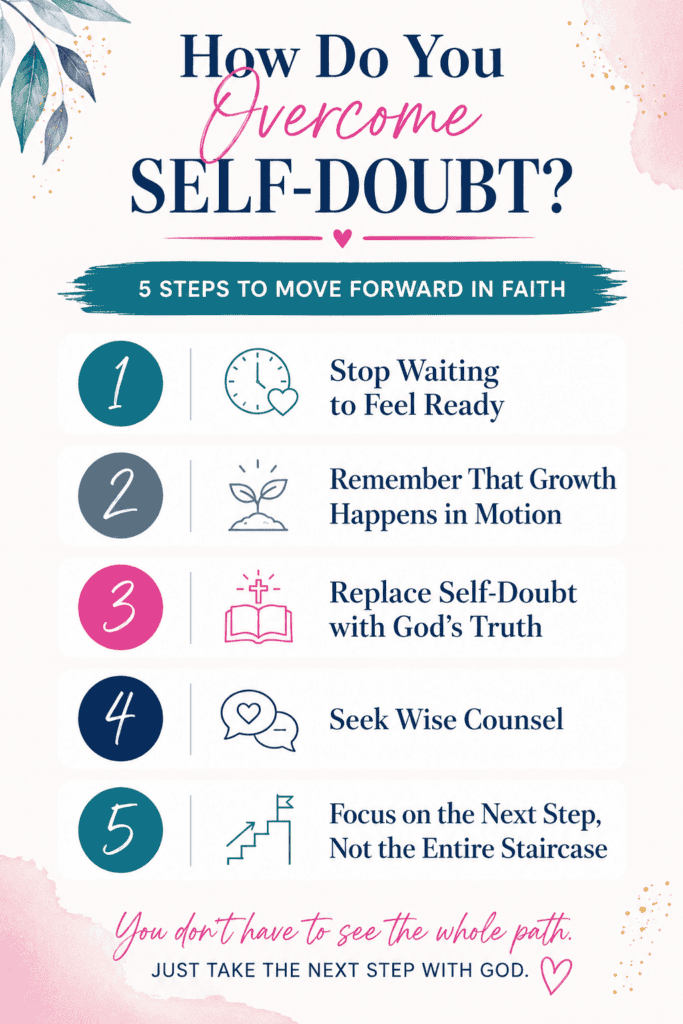
1. Stop Waiting to Feel Ready
One of the biggest myths about confidence is that confident people feel ready before they act.
They don’t.
Most people who are doing something meaningful are nervous.
They’re uncertain.
They’re learning as they go.
The difference is that they move forward anyway.
Think about Moses.
When God called him, Moses immediately started listing reasons why he wasn’t the right person.
He wasn’t a good speaker.
He didn’t feel qualified.
He wanted God to send someone else.
Yet God didn’t respond by saying, “You’re right. Let’s wait until you feel confident.”
Instead, God promised to be with him.
God’s answer to Moses’ insecurity wasn’t confidence.
It was His presence.
2. Remember That Growth Happens in Motion
It’s easy to believe that breakthrough happens in one dramatic moment.
Sometimes it does.
Most of the time, it doesn’t.
Most breakthrough happens through small, consistent acts of obedience.
One prayer.
One conversation.
One application.
One social media post.
One podcast episode.
One step.
Then another.
Then another.
The women I see make the most progress aren’t necessarily the most talented or the most confident.
They’re the most consistent.
They keep showing up even when they don’t feel like it.
They keep moving even when they can’t see the whole path.
And eventually, those small steps create momentum.
3. Replace Self-Doubt with God’s Truth
When self-doubt starts talking, don’t just listen to it.
Challenge it.
Ask yourself:
- Is this thought true?
- Does this align with God’s Word?
- Would I say this to a friend?
One practice that has helped me tremendously is writing down Scriptures that directly address the lies I’m believing.
When I think:
“I’m not capable.”
I remind myself:
“I can do all things through Christ who strengthens me.” (Philippians 4:13)
When I think:
“This is impossible.”
I remind myself:
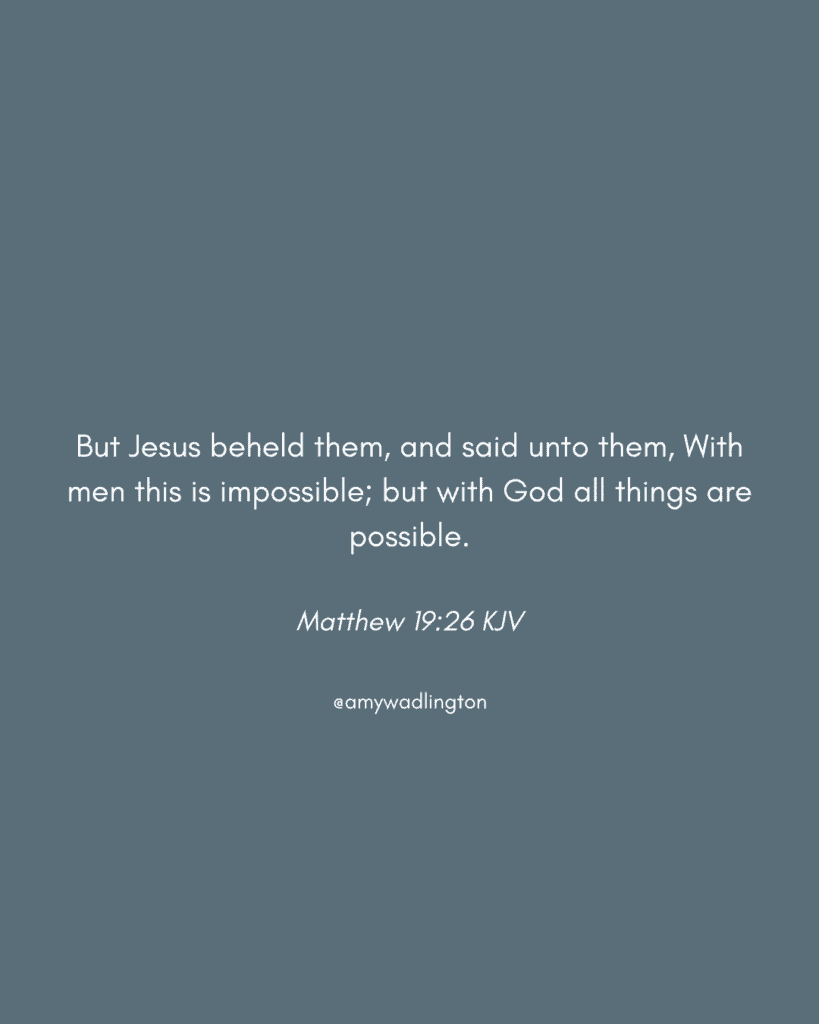
“With God all things are possible.” (Matthew 19:26)
God’s truth is stronger than your feelings.
But you have to intentionally return to it.
4. Seek Wise Counsel
Self-doubt thrives in isolation.
When you’re alone with your thoughts long enough, they start sounding like facts.
That’s why wise counsel matters.
Sometimes you need someone outside the situation to remind you of what God has already shown you.
A trusted mentor, coach, pastor, or friend can often see what you can’t see when you’re buried in fear and uncertainty.
Don’t be afraid to ask for help.
You were never meant to walk this journey alone.
5. Focus on the Next Step, Not the Entire Staircase
One reason self-doubt feels overwhelming is because we try to solve the entire future at once.
We want the whole roadmap.
God usually gives us the next step.
Not the next ten.
Just the next one.
The good news is that you don’t need to know the entire plan to obey God today.
You only need enough faith for the next step.
That’s how trust grows.
That’s how confidence grows.
That’s how breakthrough happens.
So, How Do You Overcome Self Doubt?
You overcome self-doubt by refusing to let it make your decisions.
You move forward even when you feel uncertain.
You remind yourself of God’s truth.
You seek wise counsel.
You stop waiting for perfect clarity.
And most importantly, you keep going.
Because confidence isn’t built by thinking about action.
It’s built through action.
You don’t have to know exactly where you’re going.
You don’t have to feel completely ready.
You don’t have to have every answer.
You just have to take the next step.
And then the next.
And then the next.
That’s how you move from self-doubt to breakthrough.
Want to Go Deeper?
In this week’s episode of Prophetic Breakthrough for Christian Women, I share a powerful story and practical encouragement to help you break free from self-doubt and keep moving toward your calling.

Leave a Reply


Most Binge-Worthy Episodes
The Go-To Podcast with prophetic insight to help women break free from fear, overwhelm, and confusion—so they can step boldly into their God-given calling with peace and clarity.

57
LIVE COACHING: How to Find Breakthrough When You’re Overwhelmed and Stuck
From Self-Doubt to Breakthrough: Kristin’s Story of Clarity and Trusting God
Exhausted and Ready to Quit? Build Self-Confidence by Trusting God
Stuck Between the Dream and Breakthrough? The #1 Courageous Shift That Changes Everything
Impostor Syndrome Blocking Your Clarity? How to Move Forward in God’s Plan
84
55
87
65
TOP
2%
Global Ranking
88
Spiritual Warfare 101: How to Fight Back With Faith, Authority, and Confidence

I'm Amy and I help ambitious women of faith breakthrough, get more energy & clarity, stop cravings, and finally feel good again!
Read more about me

I'm so glad you're here
Hello!
For tips and updates follow me on Insta @amywadlington
find me on

© 2026 Amy Wadlington. all rights reserved. made with Love In Colorado privacy policy
Website Design & SEO Amy Wadlington, Christian Life Coach

Praying for clariy but still feel stuck?
Stop Second-Guessing, Overthinking & Spiraling
Move Forward with Confidence